


Inside Tonkatsu: Japan's Beloved Pork Cutlet Explained
When visitors to Japan are surveyed about their favorite culinary highlights, a beautifully golden, perfectly fried pork cutlet is seldom far from the top of the list. Generous, tender cuts of meat enveloped in an exceptionally light and flaky crust, tonkatsu represents the ultimate Japanese comfort food. It is a staple of everyday home cooking and casual dining, but also a dish elevated to an art form by dedicated artisan chefs. This guide covers everything from the history and anatomy of a classic tonkatsu to the techniques that separate a good cutlet from an exceptional one.
The Anatomy of a Classic: What Exactly is Tonkatsu?
The word tonkatsu combines the Sino-Japanese word ton, meaning "pig," and katsu, a shortened form of katsuretsu, a transliteration of the French word côtelette (cutlet). That linguistic journey tells you something about the dish itself.
Tonkatsu was born during the Meiji era in the late 19th century, when Japan opened its borders and began adapting Western-style recipes to suit local tastes, a culinary movement known as yōshoku. The pork cutlet as it exists today was pioneered in 1899 at a Tokyo restaurant named Rengatei, and it has since evolved into something entirely its own.
A traditional tonkatsu experience is built around a few essential components. First is the cut of pork. Diners choose between hire-katsu, made from lean, tender fillet or tenderloin, and rosu-katsu, made from loin with a rich strip of marbled fat that melts during cooking for a noticeably sweeter, juicier result. In Japan, elite tonkatsu chefs go
further still, sourcing meat from boutique pork breeds known as meigara-buta. These animals are raised on carefully controlled diets including sweet roasted soy flour and locally sourced pumpkins, chosen specifically for how they influence the fat. The goal is a clean, delicate melting point that releases sweetness into the meat as it cooks, rather than the heavy, lingering aftertaste that lower-quality pork can leave behind. The logic is not unlike Wagyu grading: the fat is not incidental; it is the point.
The breading is equally considered. Unlike Western breadcrumbs, tonkatsu uses panko, crustless white bread processed into large, airy flakes. Many dedicated restaurants use nama panko, fresh undried breadcrumbs whose larger, airy crumbs create a delicate lattice that crisps rapidly, producing a feather-light, shatteringly crisp crust rather than anything dense or heavy.
The dish is traditionally served as a teishoku set meal, alongside rice, miso soup, and a generous mound of finely shredded raw cabbage. That cabbage is not an afterthought, its clean, crisp fiber actively counteracts the richness of the fried pork, cutting through the fat and resetting the palate between bites. A squeeze of fresh lemon sharpens the effect. The cutlet itself is finished with a thick, sweet-and-tangy Worcestershire-style tonkatsu sauce and a dab of hot yellow mustard, whose sharp acidity echoes the fat-cutting role of the cabbage.
A Tale of Two Cutlets: Tonkatsu vs. Schnitzel and Katsudon
Tonkatsu is sometimes compared to other breaded meat dishes from around the world, but the differences in technique and philosophy are significant.
A traditional German or Austrian schnitzel uses a thin fillet pounded flat and shallow-fried in a pan. Tonkatsu uses a much thicker cut, completely submerged in hot oil. That full submersion is the key: the panko casing acts as a pressurized chamber, allowing the meat to steam in its own juices, trapping natural juices and gently melting the intramuscular fat, so the thick center stays tender while the exterior crisps up completely. The two dishes share a common ancestor but arrived at very different destinations.
Tempura, Japan's other celebrated fried food, is a different technique entirely. Its coating is a wet batter of wheat flour, egg, and cold water, often fried in sesame oil for a delicate finish. Tonkatsu, categorized as a deep-fried dish, follows a three-step breading process: flour, beaten egg, then a heavy coating of panko.
Katsudon takes the tonkatsu in a different direction altogether, and it is worth understanding that the transformation is entirely deliberate. A freshly fried cutlet is sliced and simmered in a shallow pan with sweet-salty dashi broth and sliced onions. Lightly beaten eggs are added and cooked until just creamy, then the whole mixture is slid over warm rice. As the breading absorbs the broth, it becomes a vessel for the sweet-salty dashi, surrendering its crunch in exchange for something soft, yielding, and deeply comforting. The dish is not a lesser version of tonkatsu. It is a conscious reinvention of it.
The Secret to the Perfect Crunch: The Double-Fry Technique and Miso Katsu
Two techniques are worth understanding for anyone serious about getting tonkatsu right.
The first is the double-fry. The pork is initially fried at a lower temperature to cook the thick meat through gently, then lifted out to rest before a final flash in hotter oil. That resting period is as important as either frying stage. It allows residual heat to finish cooking the center quietly, so that when the cutlet hits the high heat for its final crust, the internal juices are stable rather than under pressure. The result is a shatteringly crisp exterior over a center that is fully cooked, juicy, and under no risk of drying out.
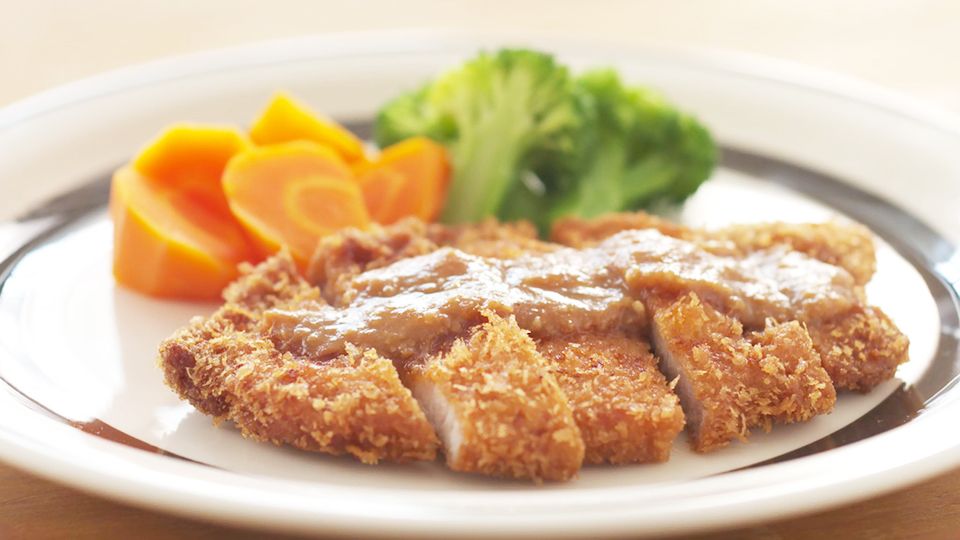
The second is the sauce. While tonkatsu is traditionally paired with its namesake condiment, a complex reduction of fruit and vegetables blended with Worcestershire sauce and ketchup, the recipe here draws inspiration from Nagoya's culinary culture. Known as Miso Katsu, this regional variation replaces the standard sauce with a bold glaze built on rich red miso paste. The addition of honey and vinegar creates a glossy, deeply savory finish that clings to the crispy panko and holds its own against the richness of the pork. Both versions are worth mastering, as they showcase just how much range a single dish can carry.
Recipe
The recipe is so simple as it is just deep-fries pork.Yet it is very delicious even though no big preparation or precooking is required.
Cutting between the fat and lean on the thickly sliced pork can prevent the pork from curving when it's fried. Adding flavor with soy sauce (not salt) enhances the taste. The crunchiness of the batter can be maintained by adjusting the thickness of the sauce with miso paste and honey.
Ingredient For two people servings
- Thickly cut pork loin 2 slices
- Soy sauce 1/2 tablespoon
- Egg 1
- Rice flour (or wheat) Appropriate amount
- Japanese bread crumbs Appropriate amount
- Miso paste 5 teaspoons
- Vinegar 4 teaspoons
- Honey 2 teaspoons
- Salad oil Appropriate amount
Cut between the fat and lean on the pork loins with kitchen scissors. Leave them for 10 minutes after rubbing soy sauce onto it. Wipe them dry. Beat the egg.
Mix miso paste, vinegar, and honey together to make a sauce.
Coat the pork loin in the rice flour., then dip them into the beaten egg and bread crumbs.
Heat the salad oil to 170 degrees, then deep-fry the pork for 3-4 minutes until it turns golden.
Cut the pork into bite-sized pieces before placing it on a place, then pour the miso sauce (2) over it.

Go Igarashi / Cooking Specialist
Igarashi is a young cooking specialist, who is seen in media widely from magazines to televisions. The multi-talented specialist is involved in a range of activities including recipe development, writing columns on nutrition, nurturing chefs, and conducting lectures, etc.
He is the president of the FoodCreativeFactory Corporation